Chapter One
How to Tell You? An Introduction
How do I tell you all I’m thinking and feeling? It’s all so complicated and yet so simple. I can reduce my thoughts to simple phrases and sentences. I can do it from two sides—black and white—although I cannot faithfully represent one as well as the other.
Simple sentences and simple divisions about this nation, this America, is an injustice. It resolves nothing. It’s like pulling off the stems of crabgrass. The problem appears resolved, but the weed returns stronger.
That is what America—or we more precisely—has done for five centuries. Everyone simplifies the problem, pushing aside resolution as too complex. Yet that’s precisely what the nation needs. Resolution will mean a new America, one not yet imagined. A better and stronger society, nation, and individuals would emerge. It would not be easy. It would involve change, and people come slowly to change.
William, America needs change. Our narrative—the nation’s narrative—must reflect accurately where we started and how, five centuries later, we arrived here. That change lies in the distance because we cling to simplistic notions of our history, especially of slavery, the Revolution, the early 19th century, the Civil War, and the years following that war. In doing so, we justify the economic, social, political, and psychological implications of our rationalizations and erroneous presumptions. We embrace our fallacies and distance ourselves from our unfettered history, pretending our past never happened.
I hope that this witness, along with those by Ta-Neshi Coates, William DuBois, John Edgar Wideman, Toni Morrison, and a host of others, will change America’s narrative. When we finally change the story of America, when we find the essence of that story, we will change the essence of us, all of us as individuals, as a society, and as a country.
Did I write this whatever-it-is in reaction to or inspired by Between the World and Me by Coates. No. It’s a brilliant book for a young African American growing up in 21st century America, for a father raising such a son, for any European American wishing to understand the fears and concerns African American parents have for their children, a fear and concern unlike those of European American parents. Coates bares his struggle to guide his maturing son through the racial labyrinth called America. Even though we’ve slain the Minotaur of burning crosses, the labyrinth remains a dangerous place for boys and young men of color.
Peel away the concern for his son, for his strength to face the evils within America and to embrace the goodness he can find here, and you discover a father worried for his kid. You might find such a thought trite. Then you probably do not have a child yet. If you do not find it trite, you already know through your son or daughter that there comes a point, a frightening point, when you realize as a parent that you cannot prevent the world from happening to your child and that you, at best, can provide only a place of safety and love. This is truer for an African American child than any other. “The power to speak, father to son, is mediated or withheld, white men, and the reality they subscribe to stand, in the way. Whites own the country, run the country, and in this world where possessions count more than people…the material reality speaks plainly to anyone who’s paying attention,” notes John Edgar Wideman in Fatheralong.[1]
This feeling of not being able to defend you, my wonderful grandson, against the morally, ethically, and legally intolerable conditions of our society frightens me, and I think too for Coates, Wideman, and millions of other African American men. A primordial instinct demands that I protect. I will feel it forever. Even as your father approaches forty, physically and financially stronger than I, I still feel the need to protect him. He doesn’t need it. It’s just that this sense, this duty, this act of love automatically comes from the inside. Mothers share the same feeling, but men express it differently, with less outward affection but with the same care and love.
There is a passion in the love and teaching of a son that men share. It’s not touchy-feely. It’s rarely tender. It’s kind of sad for it marks the loss of a little boy. Regardless, it’s necessary. There comes a time when a father must tell his son to man-up, to put away childish things, to see the legend and fantasies of American society as offered in history classes and in the movies. There’s a sadness and regret for having to prepare the lesson, to give the lesson, to see the pain that comes with the lesson. The father cheats a child of his/her dream, and no loving father wants to take that from his children or any child. More important, no father wants his child hurt or held back because he, the father, failed to explain life. We, fathers and grandfathers, just want to minimize obstacles, knowing that life, chance, and even genetics will trip you, our children, up. It’s odd that we cannot share that communal thought.
There’s a problem, though. I look at the world you’ve come into through cracked lenses, made in a European American factory designed by European Americans, sold by European Americans, all thinking that the crack was the natural confluence of all things real, meaning they could not see the crack as a flaw in their process. It was always there. You see it easily if you’re not European American. Your forefathers saw it. European Americans squint to see it. My father and mother squinted. A few teachers did as well. They showed me the crack. More important, my experiences showed me. I have no choice but to look through the crack in the lens. It is a part of me. It’s not evil in its very nature. It becomes evil only when ignored. …
[1] If you haven’t read the books of the authors mentioned, you should. They’ll give you insights into yourself and your father, and your feelings for each other.
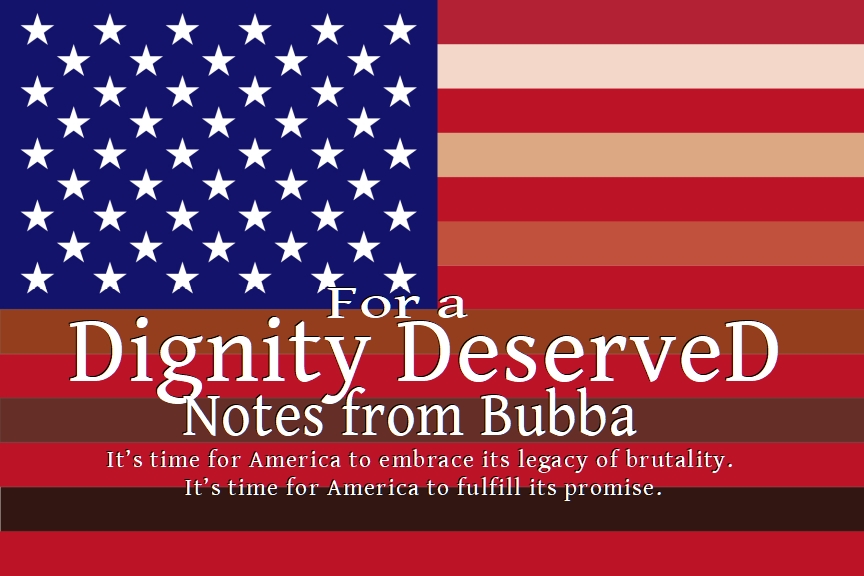
 For a Dignity Deserved