Cultural critic and historian Richard Slotkin recently wrote in The New York Times that America depends more on its myths than other modern states. We are a society composed of a highly diverse ethnic population. We need to see ourselves “as spiritual descendants of ancestors who are not related to us by blood but made kindred by our shared and continuing history.”
There’s one problem with most American myths. Most myths are based on an ethnonationalist presumption that Americans are white, even though “the crises of the 20th century…compelled the nation’s …elites to start seeing as equals the racial and ethnic minorities that had been marginalized or excluded from the body politic.” Think about it. How did the nation suddenly integrate school systems and pass civil rights protections?
In the past decade, that has changed. Slotkin notes that Donald Trump “invokes fear of racial pollution by characterizing liberal policies on immigration as the ‘poisoning’ of the American bloodstream. He identifies himself as the agent of his people’s retribution… and declares that retribution ‘allows for the termination of all rules, regulations and articles, even those found in the Constitution.’”
Myths are stories symbolizing an esteemed attribute. Take the American flag. Many individuals believe its colors represent American virtues, even though Ms. Ross borrowed the colors of the Union Jack, and the Continental Congress never assigned meaning to them when it adopted the flag in 1777. Five years later, Secretary of the Continental Congress Charles Thomson defined the meaning of the colors found in the Great Seal of the United States: red for hardiness and valor, white for purity and innocence, blue for vigilance, perseverance, and justice.
Like all myths, they represent ideals, not reality. There have been more than a few times when the nation was anything but pure and innocent. It failed to live up to its ideals. It happens: Pick up, correct the problem, and start over. We do it in our personal lives. Why not in a nation’s policies?
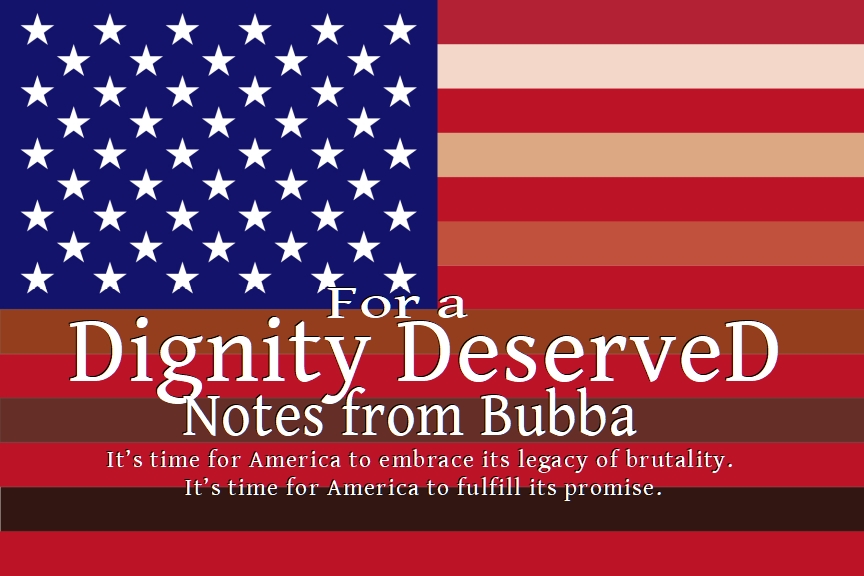
That’s how I found the logo for this blog. It has been called the inclusion flag, reportedly inspired by a Pete Seeger poem. It was on Creative Commons so that I could use it for free, but lately I cannot find it. So I asked ChatGPT to help me create an inclusion flag. The image led to this piece.

