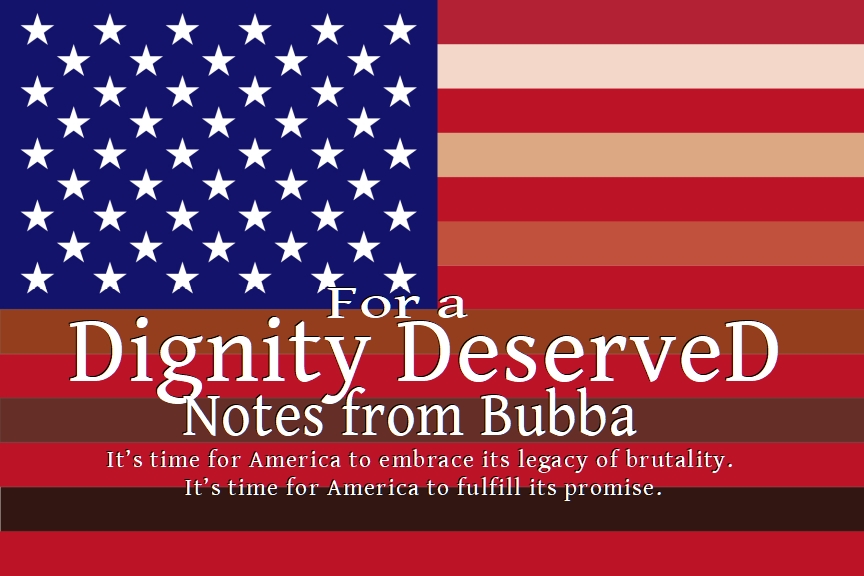
I have avoided writing about the blubber-butt we elected President. I lost my patience with the childish perlocutions that litter his speeches, press conferences, and tweets with half-truths, lies, and non-sequiturs. He paints an American portrait I don’t recognize.
The falsehoods and toadyism, sheltering him from the true America, are shields that hide a self-loathing incapable of supporting the charade of power and truth old blubber-butt wishes to project.
Return to the 1970s and 1980s, to the days when a Queens-born man struggled to find his deserved place in NYC society. Got to give him a tip of the hat. He took what Norman Porderitz called one of the world’s longest journeys. It runs from an outer borough to Manhattan. I picture Trump arm-in-arm with Frank Sinatra skipping across the 59th St. Bridge, signing, “If I can make it there, I’m gonna make it anywhere,/It’s up to you, New York, New York.”
The lyrics are arrogant but contain an element of truth. The island borough draws the best and the brightest, the talented and artistic, innovators and business geniuses, and, lest we forget, the ruthless and criminal. It chews up and spits out the overly ambitious. The elite failed to recognize the genius called Trump.
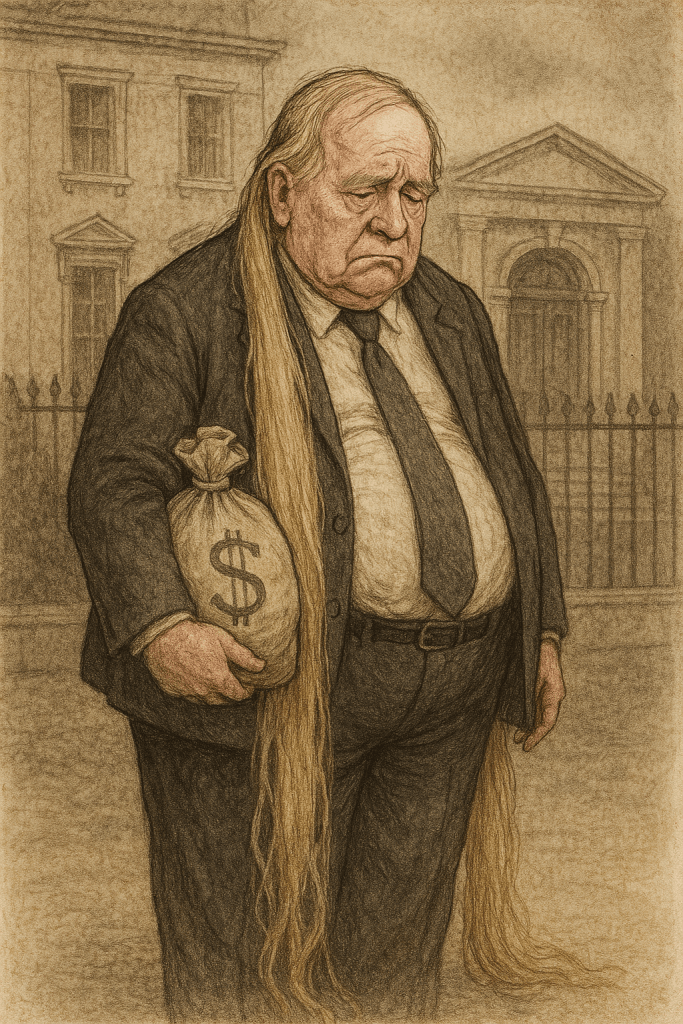
He tried hard. He had two essential tools, though, a wealthy father and the power that money buys. Or, to quote Bonfire of the Vanities by Thomas Wolfe: “He was a master of the city…with the…pretensions of an aristocrat, and he [thought he {my addition)] knew every wrinkle of the game.” He courted Manhattan’s elite in all the wrong places. He roamed Manhattan’s nightclubs, such as Studio 5, cuddling up to the fans of Bunyan’s Vanity Fair. He was the fair-haired boy of gossip columnists. The posturing and photographs plastered across Page Six of the New York Post and his bit parts in movies were for naught. The elite saw him as more a jester than prince, and their rejection vexed the little boy from Queens.
Decades later, that shortcoming, still pronounced, is a nevermind. He achieved fame by shouting you’re fired, and as that star faded, he initiated his first run for President. The second time was the charm. The man who lived in a Manhattan triplex penthouse sold his most important brand to the American people, himself. He reached a pinnacle higher than anything offered in Manhattan. He became the master of the world’s most powerful economic and military force in 2017. His thirst for acceptance was unquenchable.
He was obsessed about the size of his inauguration crowd. “But for Trump, it wasn’t really about inauguration attendance, or even popularity per se. It was about finally gaining access to the most exclusive fraternity in the world, and realizing he was still consumed with fear that he didn’t belong,” according to Mcfay Coppins in the Atlantic.
He found adulation. It came from the crowds at his rallies. Acceptance took the form of cheers, clapping, and roars of approval from people with whom he never would associate. They adopted his slogan, Make America Great Again. MAGA became a noun and adjective in the American lexicon. They spent millions on MAGA merch.
He was the great performer for frustrated Americans, playing to their fears and anger. He fictionalized the notion of a declining America. He penned lies about immigrants murdering and raping their way across America. He painted the major cities as lawless, run by some “very bad people.” He blamed the opioid epidemic on Democrats.
At the end of four years, his wonky domestic and foreign policy caught up with him. He lost re-election. Give old chicken fingers credit. He didn’t let it phase him. He tried insurrection, and when that didn’t work, he went on the road again. He whipped his crowds in a frenzy with his rhetorical weaves, as he called them, or meanderings, as they were commonly called. His felony convictions and the loss of a sexual assault lawsuit couldn’t tame the avidity of his supporters. The demagogical adoration propelled him to a Presidential victory.
Armed with the love of millions and a Republican-dominated House and Senate, he became an adulation magnet. Tech giants genuflected before him. The political elite of the conservative movement armed him with individuals who promoted whatever aspiration came to him. Trump responded by giving each whatever they wanted. The office of the Presidency became transactual, and that he understood. After successfully applying to domestic affairs, he took his road show international. And he translated the world’s toadyism as groveling before his wonder.
I was tired of the putz, or maybe I was frightened of the individuals shoring up a man with the intellect of Mr. Potato Head. I wanted silence, time without his clanging challenges to the laws and traditions of the republic.
During my isolation, I stumbled over the writings of Nazi jurist Carl Schmitt who was critical in the formation of the German Third Reich. Schmitt postulated a new concept for a constitutional republic, the state of exception. It resembles a state of emergency, which grants a state’s leader (such as a president) the authority to suspend the rule of law in the name of public order. Suspend, in this case, takes on the connotation of temporary. The state of exception, however, gives a leader the right to nullify legal orders, much as Trump has done with the reams of executive orders he signs with a flourish and then holds it up for all to see, like a first-grader showing off his latest drawing.
My escape from Trumpvision ended when he federalized the National Guard and sent them to Los Angeles to “restore” law and order. First, I must note that Trump, the man who claimed he could shoot an individual on Fifth Avenue and not get arrested, was the last person I thought of as a law-and-order politician. He was also the president who let the rioters storm the Capitol without calling out the National Guard. He was the president who wondered about shooting protestors in the legs. Let’s skip the irony and get to the basics.
Based on a few videos and photographs, he fantasized about a city in chaos. He wanted all Americans to fantasize about chaos in LA. He wanted Americans to believe California, the anathema to his America, crumbling under the weight of liberalism. The Guard and Marines mustering in the city symbolized the need for order in the face of chaos, even though the California governor and the city’s mayor requested the Arrogant-in-Chief to stand down. Nope. The troops moved in and slept on concrete floors as LA’s finest handled the mostly peaceful demonstrators.
In the dull-witted imagination of Trump, “radical liberals” were protesting the execution of a chaotic deportation program. It was a program of theater intended to cinematically project Trump’s militaristic efforts to rid the nation of rapists, murderers, terrorists, and the insane flowing into an undefended America. It was all pomp, vanity, and ostentation, proving he was as strong as Putin and Xi. That was all that was new about his policy, its execution. The federal government always deported illegal immigrants convicted of felonies. His electioneering promised to do more of the same. So, “his” deportations needed theatrics to fulfill the fantasies of his followers.
Safety wasn’t the issue. It’s race.
Immigrants leave home, family, friends, culture, and language for reasons more powerful than to live in the land of the free. Starting with the Puritans, immigrants have come to the “new” world to escape persecution and poverty. When South African farmers complained of persecution, unjustifiably labeled genocide, Trump invited them to America. Were they vetted for criminal activity? Nope. They were White. They had what our Commander of Eugenics calls “good” genes. Those from Latin America and South America have “bad” genes. He can tell. Look at them. Their skin is brown.
The solipsistic notion pervades his Administration. His chief policy adviser, Stephen Miller, for example, has “advocated many of the most extreme white supremacist concepts. These included the ‘great replacement’ theory, fears of white genocide through immigration, race science, and eugenics; he also linked immigrants with crime, glorified the Confederacy, and promoted the genocidal book, The Camp of the Saints, as a roadmap for US policy,” according to American Progress. In simple terms, Trump’s policies and those of his devotee are racist.
Miller triggered the protests in LA. Shortly before ICE moved into the city, Miller screamed at ICE officials, demanding that they increase the number of deportees by pulling people off the streets outside Home Depot and farms. People were being separated from their families without notice or due process. They were detained regardless of their immigration status. Those reporting to immigration bureaus, as required for their status, were picked up by ICE agents. American citizens have been detained—without cause. Their crime: Having dark skin. Meanwhile, the President, who prefers to darken his pale skin, imposed visa restrictions on people coming mostly from African countries.
As he stripped away the normal rights granted to individuals in this country or coming to this country, I remembered a line from the movie Inherit the Wind (1999), which fictionalized the 1925 Scopes Monkey Trial: In defense of the man who taught evolution in a high school, the attorney Henry Drummond sums up a great fear for any democracy: “If you can do one, you can do the other because fanaticism and ignorance are forever busy and need feeding. And soon…with banners flying and with drums beating, we’ll be marching backward, backward through the glorious ages of that Sixteenth Century when bigots burned the man who dared bring enlightenment and intelligence to the human mind!”
This past weekend, more than five million exceptional Americans demonstrated their revulsion to the execution of his immigration policies. They were protesting fanaticism and ignorance. They were hoping to arrest a retreat into a past when immigrants were considered unAmerican, or more precisely, a past where intolerance, the lack of empathy, and outright racism were standards honored.
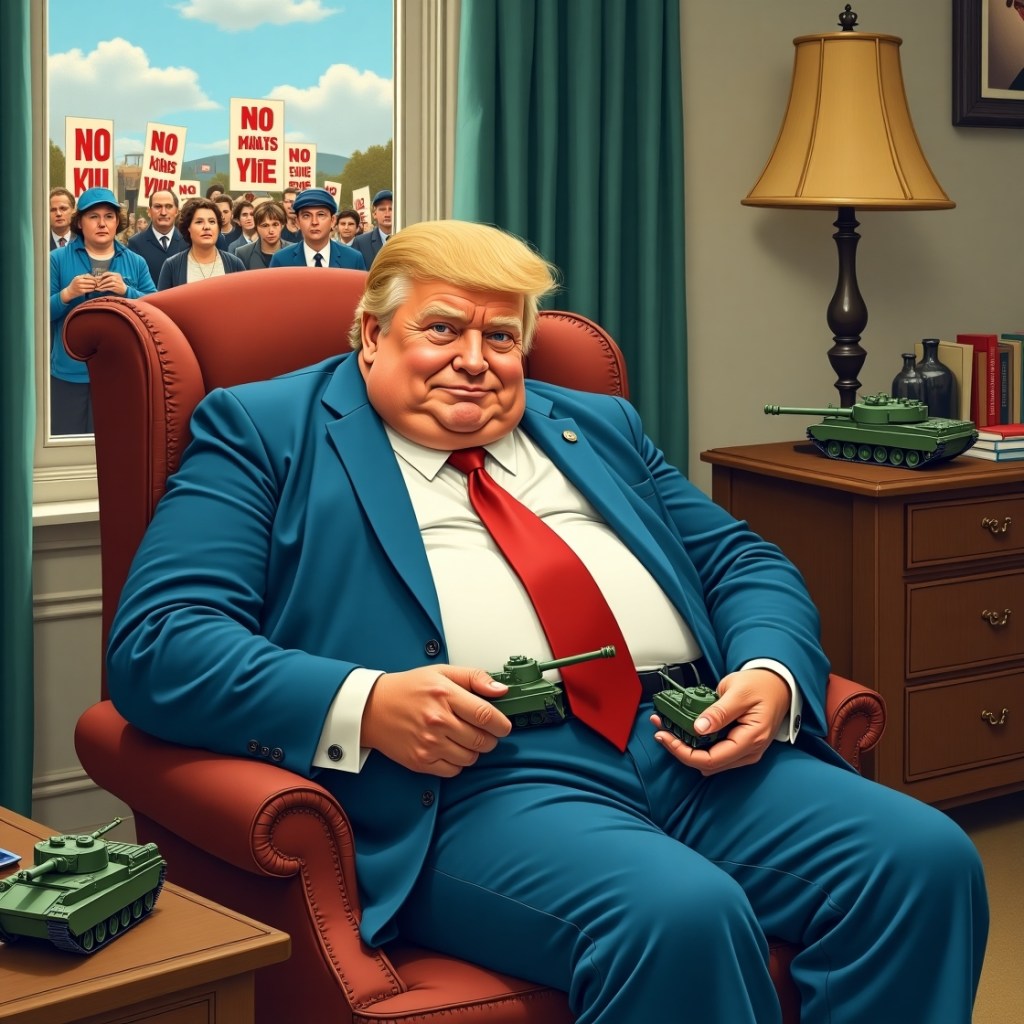
That mattered not a flick as he dispiritedly watched his long-sought parade. It was a dream that started in the romantic city of Paris. He stood with President Emmanuel Macron before a military parade, and Trump wished aloud for such a time in America. He found an excuse. Flag Day, his birth date, was the day the Army planned to celebrate its 250th anniversary. The initial celebration was simple. Demonstrations and booths on the National Mall. There would be no marching troops or rolling tanks. It was a fitting tribute to the service men and women who never swear allegiance to a president or political party. Their oath is to defend the Constitution, a document Trump has never read and hates to comply with.
Fortitude was in short supply in the West Wing. Nobody said no to our little Commander-in-Chief. They let him play the military hero for two hours. He felt a sense of unexceptional glory. He was loved as thousands of men and women marched in his honor, along with the 250,000 spectators on the Mall and in the stands. He sucked in their power, honor, and fortitude, forgetting he lacked the courage of those soldiers when he was their age. He never thought of the 1700 Guardsmen sleeping on concrete floors because there was nothing for them to do in LA.
A few days later, I wondered if Schmitt would rethink his theory of exception if he witnessed Trump’s reich.
 For a Dignity Deserved